AI-Driven Shopping: Why Your Product Pages Are Now Invisible (And How to Fix It)
Traditional SEO is dying. ChatGPT and Perplexity are becoming the new shopping search engines. Learn how LLM-optimized product data and GEO (Generative Engine Optimization) will determine which e-commerce brands survive the AI shopping revolution.
The Death of "Best Running Shoes 2025" Searches
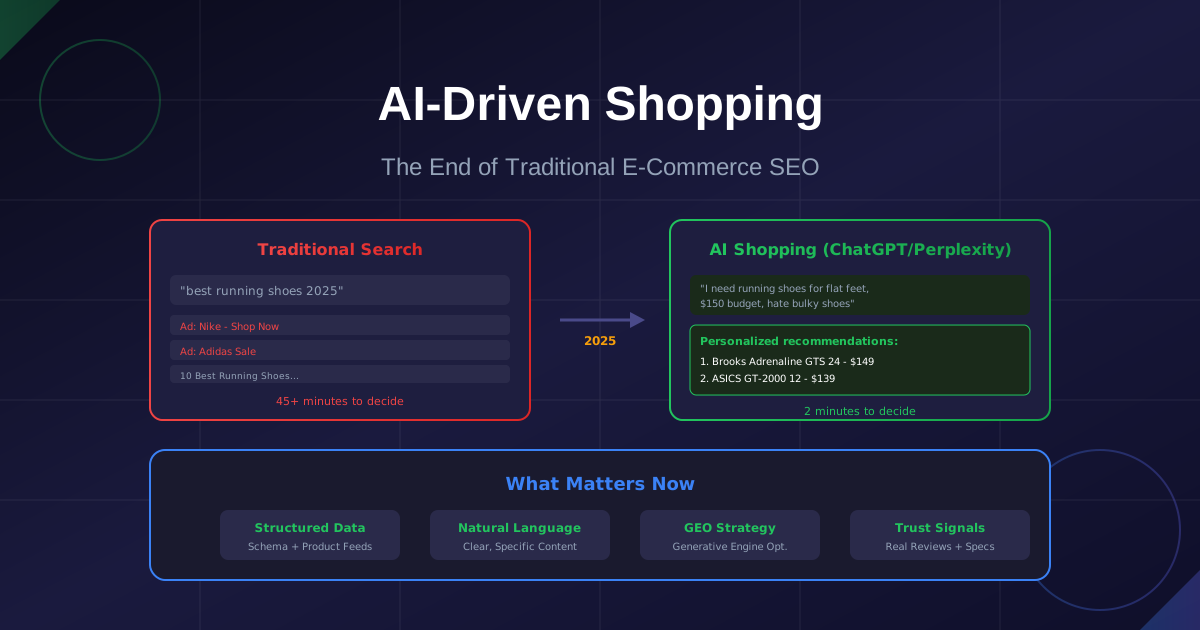
Here's what's actually happening right now: A shopper opens ChatGPT and types "I need running shoes for flat feet, budget around $150, and I hate shoes that feel bulky." Within 30 seconds, they get a curated shortlist with explanations of why each shoe works for their specific situation—complete with pricing, where to buy, and honest assessments of trade-offs.
No scrolling through 10 blue links. No reading 15 different "best of" listicles written for SEO rather than humans. No sponsored results disguised as recommendations.
This isn't the future. This is November 2025.
OpenAI launched ChatGPT Shopping Research on November 24th. Perplexity's "Buy with Pro" feature now processes one-click purchases. Google's AI Overviews are cannibalizing their own search results pages. And if you're still optimizing your product pages for "best [product category] [year]" keywords, you're optimizing for a dying paradigm.
What "AI-Driven Shopping" Actually Means (Beyond the Buzzwords)
Let me cut through the marketing noise and explain what's technically happening when someone shops through an LLM instead of Google.
Traditional search engines work through keyword matching and link authority. You search "best vacuum cleaner," Google identifies pages that contain those words, ranks them by backlinks and other signals, and shows you a list. The content that wins isn't necessarily the most helpful—it's the content that best plays the SEO game.
LLM-based shopping assistants work fundamentally differently. When you ask ChatGPT for vacuum cleaner recommendations, here's what actually happens:
The model parses your natural language query to understand intent, not just keywords. "I have two dogs, hardwood floors, and my old Dyson is too heavy" contains no traditional product keywords, but an LLM understands you need a lightweight vacuum with strong pet hair pickup that works on hard surfaces.
Then the model searches its training data and real-time web access to find products matching that semantic understanding. It doesn't care if a product page is "optimized for SEO"—it cares if the product description clearly explains what the vacuum does, who it's for, and why those features matter.
Finally, it synthesizes information from multiple sources into a coherent recommendation, citing its reasoning. This is the key difference: the LLM becomes a trusted advisor, not a list of links you have to evaluate yourself.
Why Your Keyword-Stuffed Product Pages Are Now Invisible
Here's the uncomfortable truth that most e-commerce teams haven't internalized: content written for search engine crawlers often performs terribly with LLMs.
Think about a typical "SEO-optimized" product description:
"The XYZ Pro Vacuum Cleaner is the best cordless vacuum cleaner for pet hair. This powerful cordless vacuum features advanced suction technology for pet hair removal. Our cordless vacuum cleaner is perfect for pet owners looking for the best vacuum cleaner for dog hair and cat hair."
A human reads that and thinks "this is keyword-stuffed garbage." An LLM reads that and thinks the same thing—because LLMs are trained on human-written text and learn to recognize (and deprioritize) content that sounds unnatural.
Compare that to:
"Designed specifically for multi-pet households, the XYZ Pro delivers 150AW of suction power—roughly 3x what you'll find in budget models—through a 0.5L dustbin that's easy to empty without touching the contents. At 5.2 lbs, it's light enough for extended cleaning sessions, though the 40-minute runtime means larger homes may need a mid-clean charge."
The second description contains zero instances of "best vacuum cleaner" or "pet hair," but an LLM can extract exactly what the product does, for whom, with what trade-offs. That's what gets recommended.
GEO: The New SEO (And Why Most Agencies Don't Understand It Yet)
The industry is starting to use "GEO" (Generative Engine Optimization) to describe this new discipline, but most definitions miss the point entirely. GEO isn't about optimizing for ChatGPT the way we optimized for Google. It's about fundamentally rethinking what "discoverability" means in an AI-mediated world.
Here's what I mean: In traditional SEO, you could game the system. Buy backlinks, stuff keywords, create thin content at scale—and as long as you stayed one step ahead of Google's algorithm updates, you could rank.
LLMs don't work that way. They're trained on massive corpora of human text and develop an implicit understanding of what "helpful, accurate, well-written content" looks like. You can't trick a language model into thinking keyword-stuffed garbage is high-quality content—it literally knows what good writing looks like because it was trained on billions of examples.
This is actually liberating for brands that create genuinely good products and genuinely helpful content. But it's terrifying for brands that have relied on SEO tricks to punch above their weight.
The New E-Commerce Visibility Stack
Based on how ChatGPT Shopping and Perplexity work, here's what actually matters for AI-driven product discovery:
1. Structured Product Data (The Foundation)
LLMs can read and parse your product pages, but they work much better with structured data. This means:
Complete schema markup that explicitly defines product attributes, pricing, availability, reviews, and specifications. Don't just have this information visible on the page—mark it up so machines can reliably extract it.
Consistent attribute formatting across your entire catalog. If one product lists weight in pounds and another in kilograms, an LLM might misinterpret comparisons. Standardize everything.
Rich specification tables with actual numbers, not vague descriptors. "Long battery life" means nothing. "8 hours at moderate usage, 5 hours at maximum performance" is actionable data.
2. Natural Language Product Descriptions (The Content)
Your product descriptions need to answer the questions a thoughtful sales associate would anticipate:
What is this product, specifically? Not what category it's in—what does THIS particular item do?
Who should buy it? Be specific about use cases. "Great for everyone" is useless. "Ideal for commuters who carry laptops and need quick-access pockets for transit cards" is useful.
What are the actual specifications? Numbers, measurements, materials, compatibility details.
What are the trade-offs? This is counterintuitive for marketers, but LLMs (and users) trust content that acknowledges limitations. "Not recommended for heavy gaming due to integrated graphics" builds more credibility than claiming a laptop is "perfect for everything."
How does it compare to alternatives? You don't need to trash competitors, but contextualizing your product within the market helps LLMs understand where it fits.
3. Contextual Supporting Content (The Ecosystem)
Individual product pages don't exist in isolation. LLMs consider the broader context of your site:
Buying guides that explain how to choose between product categories. These help LLMs understand which of your products to recommend for specific user needs.
Comparison content that honestly evaluates your products against competitors. Yes, this feels risky—but it builds the kind of authoritative positioning that LLMs reward.
FAQ content that addresses real customer questions, not just questions you wish they'd ask. Check your customer service tickets for actual pain points and confusion.
4. Trust and Authority Signals (The Credibility)
LLMs are increasingly able to assess source reliability. This means:
Reviews that contain specific details about product usage, not just "Great product 5 stars!" The more specific and scenario-based your reviews, the more useful they are for LLM recommendations.
Expert mentions and citations from trusted sources in your industry.
Clear business information including return policies, warranty details, and customer service accessibility.
The Hiring Trend That Signals Where This Is Going
Here's something most people missed: agencies are now hiring specifically for "AI Shopping Optimization" and "Product Feed for LLM" roles. This isn't just SEO people with updated job titles—it's a recognition that the skill set required is fundamentally different.
Traditional SEO expertise: keyword research, backlink building, technical site audits, content templating for scale.
AI shopping optimization expertise: structured data architecture, natural language content strategy, semantic product categorization, LLM prompt understanding.
The overlap is smaller than you'd think. Many successful SEO practitioners are struggling with this transition because their instincts (optimize for keywords, build links, create more content) don't translate to LLM optimization (optimize for clarity, build trust through specificity, create better content).
If you're building an e-commerce team right now, look for people who understand:
- How language models process and evaluate text
- Structured data and schema markup at a deep level
- Content strategy focused on user intent rather than keyword volume
- Product information management (PIM) systems
The Brutal Math: First-Sentence Visibility
Here's something that should terrify (or excite) you: in AI-driven shopping, your first sentence might be the only thing that gets seen.
When ChatGPT generates a product recommendation, it doesn't show users the entire product page. It synthesizes the key information into a brief summary. If your product description leads with fluff—"Introducing the revolutionary new XYZ that will change how you think about..."—that's what the AI extracts. And that's what loses to competitors who lead with substance.
The new best practice: front-load your product descriptions with the most important, specific information. Put the key differentiator, the primary use case, and the most relevant specification in the first sentence or two.
Not: "Experience the next generation of audio technology with our premium wireless earbuds."
Instead: "40-hour battery life with ANC, specifically tuned for clarity on voice calls—the XYZ Earbuds solve the biggest complaint about working from home audio."
The second version tells an LLM exactly what the product does best and who it's for. That's what gets recommended.
What ChatGPT Shopping Actually Does (Technical Deep-Dive)
Let me explain what's happening under the hood when someone uses ChatGPT for shopping research, because understanding this helps you optimize for it.
ChatGPT Shopping Research (launched November 24, 2025) runs on a specialized GPT-5 mini model optimized specifically for shopping tasks. When a user asks for product recommendations:
Step 1: Intent Parsing The model analyzes the natural language query to understand not just what product category is being requested, but the specific use case, constraints, preferences, and implicit requirements. "I need a laptop for my daughter starting college, she's studying graphic design" triggers understanding of: student budget sensitivity, creative software requirements, portability needs, reliability importance.
Step 2: Web Search & Data Extraction The model searches the open web and extracts information from product pages, review sites, and comparison content. It prioritizes sources that provide specific, quantified information over those that provide generic marketing copy.
Step 3: Synthesis & Recommendation Rather than returning a list of links, the model synthesizes the information into a coherent recommendation with reasoning. It explains WHY each product is recommended for THIS user's specific situation.
Step 4: Refinement Users can mark recommendations as "More like this" or "Not interested," and the model refines its suggestions accordingly. This feedback loop means the model learns user preferences within the conversation.
Coming Soon: Instant Checkout OpenAI announced that participating merchants will soon be able to enable purchases directly within ChatGPT. This means the entire purchase journey—from intent to transaction—can happen without the user ever visiting a traditional product page.
Perplexity's Approach: The "Buy with Pro" Disruption
Perplexity has taken a different but equally disruptive approach. Their shopping experience emphasizes one-click purchasing through their "Buy with Pro" feature, which offers:
Free shipping on all orders Free returns with no hassle AI-curated selections based on deep product research
The key insight from Perplexity's approach: they're positioning AI as the trusted curator that eliminates the need for traditional product research entirely. Users don't visit multiple sites to compare—they ask Perplexity, get a recommendation, and buy.
For brands, this means the battle for visibility increasingly happens in the data layer, not on your website. If your product data doesn't clearly communicate what makes your product the right choice for specific use cases, you won't be recommended—and users will never see your carefully designed product pages, your brand story, or your premium imagery.
The Uncomfortable Questions Every E-Commerce Brand Must Answer
Let me be direct about what this shift means for your business:
Question 1: Can an AI accurately describe your product without visiting your website?
Test this yourself: Ask ChatGPT or Perplexity about products in your category. When they mention your competitors, what information do they surface? When they mention (or don't mention) your products, why?
Question 2: Does your product data stand alone?
Strip away your brand name, your imagery, your website design. Does the raw product information—specifications, features, use cases—clearly communicate why someone should choose your product? Or does your differentiation rely on things AI can't parse?
Question 3: Are you optimizing for the right discovery channel?
If 30% of your target audience starts their product research in ChatGPT rather than Google (a number that's growing rapidly), your Google-optimized content strategy is reaching a shrinking audience. Are you adapting?
Question 4: Is your first sentence your best sentence?
Review your product descriptions. What appears in the first 20 words? Is it marketing fluff or substantive differentiation? In AI-driven shopping, that opening might be your only shot.
A Practical Framework: The 48-Hour AI Shopping Audit
Here's a concrete process you can run this week to assess your AI shopping readiness:
Hour 1-4: Query Testing Ask ChatGPT and Perplexity questions that your target customers would ask. Document whether your products appear, how they're described, and what competitors are recommended instead.
Hour 5-12: Data Layer Audit Review your product schema markup. Is it complete? Accurate? Consistent across your catalog? Use Google's Structured Data Testing Tool as a baseline, but go deeper—what information is available in structured form vs. only in unstructured content?
Hour 13-24: Content Rewrite Take your 10 best-selling products and rewrite their descriptions using the principles in this article. Lead with substance, include specific use cases, acknowledge trade-offs, quantify claims.
Hour 25-36: Comparison Content Create or update buying guides that honestly compare your products to alternatives. Help LLMs understand where your products fit in the market.
Hour 37-48: Review Mining Analyze your reviews for specific, useful information. Reach out to customers who left detailed reviews and ask if you can feature their use-case stories more prominently.
The Bottom Line: Adapt or Become Invisible
The brands that will thrive in AI-driven shopping are those that treat product data as a first-class strategic asset—not an afterthought to their visual merchandising and brand marketing.
This doesn't mean abandoning traditional marketing. Brand building, visual design, and customer experience still matter enormously for conversion once customers reach your site. But the path TO your site is fundamentally changing, and the old playbook of keyword optimization and link building is becoming less relevant by the month.
The question isn't whether AI shopping will become dominant—ChatGPT and Perplexity are proving that it already is for a significant and growing segment of consumers. The question is whether your product data will be ready when those consumers ask an AI what to buy.
If your products don't show up in those recommendations, all the traditional SEO work in the world won't matter. You'll be optimized for a search paradigm that's being left behind.
Want help auditing your product data for AI shopping readiness? Check out our AI tools for e-commerce optimization, or reach out on X/Twitter for a conversation about how these changes affect your specific market.
Autor

Categorias
Mais Posts

Best 4K AI Image Generator Tools in 2026: Create Ultra HD Images
Discover the best AI image generators for creating stunning 4K resolution images. Compare Midjourney, FLUX, Stable Diffusion, and free upscaling tools. Complete guide with tips for generating high-resolution AI art.

Best AI Ad Copy Generator Tools in 2026: Create High-Converting Ads
Discover the best AI ad copy generators for Google Ads, Facebook, Instagram & LinkedIn. Compare Copy.ai, Jasper, Writesonic, and free tools. Complete guide with tips for generating performance-driven ad copy variations.

Best AI Product Description Generator for Shopify in 2026
Discover the best AI product description generators for Shopify stores. Learn how to write compelling product descriptions that convert using AI tools like Shopify Magic, ChatGPT, and more. Complete guide with prompts and examples.
Need a Custom Solution?
Still stuck or want someone to handle the heavy lifting? Send me a quick message. I reply to every inquiry within 24 hours—and yes, simple advice is always free.
Fique à Frente
Receba novas ferramentas primeiro
Inscreva-se para ser notificado quando lançarmos novas ferramentas de IA. Sem spam, apenas atualizações de produto.