ProductScope AI: The All-in-One Creative Studio That's Making Expensive Product Shoots Obsolete
Deep dive into ProductScope AI's PS Studio - how this all-in-one creative platform is helping e-commerce brands generate stunning product photos, optimize Amazon listings, and automate marketing content at a fraction of traditional costs.
The $5,000 Product Photoshoot Problem
Let me paint a familiar picture: You've sourced a great product, negotiated with manufacturers, invested thousands in inventory, set up your Amazon or Shopify store... and then you realize your product photos look like they were taken in a basement with a flip phone.
Professional product photography isn't cheap. A basic studio shoot runs $500-2,000 per product. Need lifestyle shots? Add another $1,000-3,000. Multiple angles, different backgrounds, seasonal variations? You're looking at $5,000+ per SKU before you've sold a single unit.
For enterprise brands with massive budgets, this is just part of the cost of doing business. For everyone else—indie sellers, small brands, bootstrapped startups—it's a barrier that keeps them looking amateur in a marketplace where visual quality directly correlates with conversion rates.
This is the problem ProductScope AI set out to solve. And after testing it extensively, I can tell you: they've built something that fundamentally changes the economics of e-commerce content creation.
What ProductScope AI Actually Is (Beyond the Marketing)
ProductScope AI positions itself as an "all-in-one creative studio for e-commerce," which sounds impressive but vague. Let me break down what that actually means in practice.
At its core, ProductScope AI is a platform that combines several distinct capabilities that e-commerce sellers typically need separate tools for:
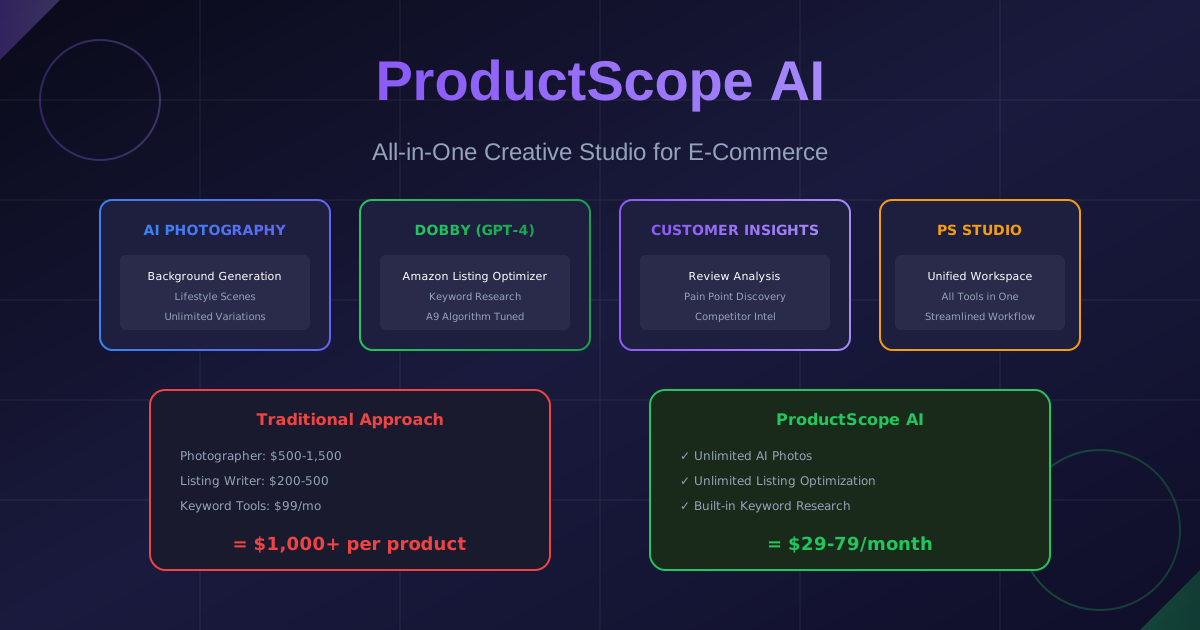
AI Product Photography (The Photoshoot Tool) takes your existing product images—even basic ones shot on a plain background—and generates professional-looking lifestyle scenes, studio setups, and contextual backgrounds. You're not just removing backgrounds; you're creating entirely new visual contexts for your products.
Amazon Listing Optimization uses GPT-4 integration to analyze your product data and generate optimized titles, bullet points, and descriptions based on keyword research and competitor analysis. This is specifically tuned for Amazon's A9 algorithm.
Customer Insight Analysis lets you understand what customers are saying about products in your category—pain points, desires, language patterns—so you can position your products more effectively.
PS Studio is their unified workspace that combines all these tools into a single dashboard where you can manage research, content generation, and asset creation without switching between platforms.
The key insight here: ProductScope isn't trying to be the best at any single thing. It's trying to eliminate the friction of using five different tools that don't talk to each other.
The "Dobby" Feature: Why Amazon Sellers Are Obsessed
Among ProductScope users, there's an almost cult-like enthusiasm for something called "Dobby"—their GPT-powered Amazon assistant. After using it, I understand why.
Most AI writing tools generate generic marketing copy that sounds like every other AI-generated marketing copy. Dobby is different because it's specifically trained on Amazon listing conventions, keyword integration patterns, and the structural requirements that the A9 algorithm rewards.
When you feed Dobby your product information, it doesn't just write a description. It generates listing content structured around specific search terms, with natural keyword density that doesn't read like keyword stuffing, formatted in the way that Amazon's algorithm tends to favor.
The unlimited keyword research feature is particularly valuable. Instead of paying for separate keyword research tools like Helium 10 or Jungle Scout, you can discover high-volume, low-competition keywords directly within the platform and immediately incorporate them into your listing copy.
Is it perfect? No. The AI occasionally generates content that needs human editing for brand voice consistency. But as a first draft generator that understands Amazon-specific requirements, it's genuinely useful.
The Photoshoot Tool: Where the Real Magic Happens
Let's be honest about what AI product photography can and can't do in 2025.
What it does well: Taking a clean product shot on a white or solid background and placing it in contextual scenes. ProductScope can generate your supplement bottle on a marble countertop, your kitchen gadget in a lifestyle kitchen setting, your skincare product in a spa-like environment. The results are often indistinguishable from photos that would cost hundreds to produce traditionally.
What it struggles with: Complex product geometries, highly reflective surfaces, and products that need to show specific details or textures. If you're selling jewelry with intricate details or watches with precise dial rendering, AI-generated backgrounds can sometimes create uncanny valley effects where the lighting on the product doesn't quite match the generated environment.
The practical workflow looks like this: You upload your base product image (ideally on a clean white background), describe the scene you want ("luxury bathroom counter with morning light"), and ProductScope generates multiple variations. You can iterate on prompts, adjust styles, and download high-resolution outputs suitable for Amazon listings, social ads, or your own website.
Where ProductScope differentiates from generic AI image tools like Midjourney or DALL-E is the e-commerce-specific training. The generated scenes tend to feature appropriate props, lighting styles, and compositions that work for product marketing rather than artistic expression.
The Honest Assessment: What's Actually Good and What's Frustrating
After extensive testing and reading through hundreds of user reviews, here's my honest breakdown:
What Users Love
Speed of iteration is the standout benefit. What used to take weeks of back-and-forth with photographers and designers now happens in minutes. You can test different visual concepts, seasonal themes, and lifestyle contexts without committing budget.
Amazon-specific features genuinely understand the platform. The keyword research, listing optimization, and A+ content generation are tuned to what actually works on Amazon, not generic e-commerce advice.
Cost predictability matters for small sellers. Instead of variable per-project costs, you're paying a monthly fee that covers unlimited generation—making it viable to create extensive visual libraries for large catalogs.
What Frustrates Users
Credit limitations on some plans can feel restrictive if you're processing large catalogs or testing many variations. The lifetime deal from AppSumo offers generous limits, but standard monthly plans require careful credit management.
Learning curve for best results exists despite the user-friendly interface. Getting consistently good AI-generated photos requires understanding prompting, knowing when your source image quality is sufficient, and developing a workflow for quality control.
Integration limitations with platforms beyond Amazon remain a pain point. While Amazon integration is robust, sellers on other platforms (Shopify, eBay, Etsy) have fewer automated workflow options.
Who ProductScope AI Is Actually For (And Who Should Skip It)
Based on my testing and analysis of user feedback, here's who gets the most value:
Ideal Users
Amazon private label sellers are the sweet spot. If you're launching products on Amazon and need professional visuals plus optimized listings without hiring separate photographers, copywriters, and keyword researchers, ProductScope consolidates those needs efficiently.
Small teams managing large catalogs benefit from the economics. When you have 50+ SKUs that need visual variations for different seasons, promotions, or A/B testing, the per-image cost with traditional methods becomes prohibitive.
Bootstrapped brands entering crowded categories can punch above their weight visually. If you're competing against established brands with professional photography budgets, AI-generated visuals close the gap significantly.
Marketing agencies serving e-commerce clients can increase throughput without proportionally increasing costs. The ability to quickly generate visual concepts for client approval speeds up the creative process.
Who Should Look Elsewhere
Brands where photography IS the product (fashion, jewelry, luxury goods) may find AI limitations more apparent. When customers are paying premium prices, the subtle imperfections of AI-generated imagery might undermine perceived value.
Sellers focused primarily on platforms other than Amazon won't get as much value from the Amazon-specific features that represent a significant portion of ProductScope's functionality.
Those needing video content primarily should note that while ProductScope has expanded into video, it's not their core strength. Dedicated video tools might serve better for video-first strategies.
The Competitive Landscape: How ProductScope Compares
ProductScope operates in a crowded space. Here's how it stacks up against alternatives:
vs. Flair AI
Flair AI focuses purely on product photography with arguably more sophisticated image generation. But it lacks the Amazon listing optimization and keyword research that makes ProductScope a more complete solution for Amazon sellers. If you only need visuals and don't care about listing copy, Flair might produce better images.
vs. WeShop AI
WeShop emphasizes fashion and apparel product photography with virtual model capabilities. It's more specialized, which means better results in its niche but less versatility across product categories. ProductScope is more generalist.
vs. Helium 10 / Jungle Scout + Canva Combo
Many sellers use Helium 10 or Jungle Scout for keyword research, then Canva or similar for visual creation. This combination offers deeper capabilities in each area but requires managing multiple subscriptions and workflows. ProductScope's advantage is integration, not necessarily depth in any single area.
vs. Hiring Freelancers
For comparable quality in both visuals and copy, hiring freelance photographers and Amazon listing specialists typically costs $500-2,000 per product. ProductScope's monthly fee makes economic sense once you're dealing with more than 2-3 products per month.
The Bigger Picture: What ProductScope Represents
ProductScope AI is part of a broader shift in e-commerce tooling that's worth understanding even if you never use the specific product.
The traditional e-commerce tech stack looks something like: product photography tools + listing optimization tools + keyword research tools + competitor analysis tools + content management systems. Each tool is best-in-class for its function, but the integration burden falls on the seller.
ProductScope and similar "all-in-one" platforms represent a bet that integration value exceeds specialization value for most small-to-medium sellers. You sacrifice some depth for workflow efficiency. You accept "good enough" in each area to get "much better" overall productivity.
This trend is accelerating across e-commerce tooling. We're seeing consolidation around platforms that do many things adequately rather than one thing exceptionally. For sellers who don't have the time or expertise to orchestrate best-in-class tools, this is probably the right trade-off.
For sellers who are already experts at Amazon optimization and just need specific capabilities, ProductScope might feel like paying for features they don't need or that don't match their established workflows.
Practical Tips: Getting Maximum Value from ProductScope AI
If you decide to try ProductScope, here are the workflows that seem to generate the best results based on user feedback:
For AI Photography
Start with the highest quality source images you can. Clean white backgrounds, good lighting, multiple angles. The AI can work with mediocre source images, but the output quality is directly correlated with input quality.
Use specific, detailed prompts. "Modern kitchen" produces generic results. "Morning light streaming through window onto white marble countertop, fresh herbs in background, minimalist Scandinavian kitchen" produces results that feel intentional.
Generate more variations than you think you need. The AI is fast and credits are (relatively) cheap. Generate 10 variations, pick the best 2. This is faster than trying to prompt your way to perfection in one attempt.
For Listing Optimization
Feed Dobby real customer review data from your competitors. The AI does better when it understands the actual language customers use to describe products in your category.
Don't just accept the first output. Use the generated content as a starting point, then iterate. Ask for more keyword-dense versions, ask for versions that emphasize different benefits, compare outputs.
Export to PDF for approval workflows if you're working with clients or team members. The formatting is clean and professional.
For Keyword Research
Start broad and go narrow. Begin with category-level keyword research to understand the landscape, then drill down into specific product niches.
Cross-reference with actual search volume data. ProductScope's keyword suggestions are useful, but validating with Amazon's own search frequency data (via Brand Analytics if you have access) improves targeting.
The Verdict: Is ProductScope AI Worth It?
Let me give you the straightforward answer based on different scenarios:
If you're an Amazon seller launching 3+ products per year, ProductScope pays for itself almost immediately. The combination of AI photography and listing optimization eliminates the need for separate tools and freelancers that would cost significantly more.
If you're running an e-commerce agency, the productivity gains are substantial. You can turn around professional-looking product concepts in hours rather than days, which matters for client relationships and project throughput.
If you're a single-product brand with established photography, you probably don't need this. The value proposition is strongest when you're dealing with scale—multiple products, frequent variations, ongoing optimization needs.
If you're selling primarily on platforms other than Amazon, you'll use maybe 60% of what you're paying for. The Amazon-specific features are excellent, but they're not transferable to other marketplaces.
The broader question isn't whether ProductScope is "good"—it clearly delivers value for its target users. The question is whether the all-in-one approach matches your workflow needs and whether you're willing to accept "very good at many things" instead of "exceptional at one thing."
For most small-to-medium e-commerce sellers, that trade-off makes sense. The friction of coordinating multiple tools and service providers is a real cost that ProductScope eliminates.
For sellers who have already optimized their workflows with best-in-class tools in each category, ProductScope might feel like a step backward in certain areas—even if the integration benefits are real.
Building an e-commerce brand and need more tools? Check out our AI tools for e-commerce including product photography generators, listing optimizers, and more.
Author

Categories
More Posts

The 7 Best AI Tools for Shopify Stores in 2026 (US Market Guide)
Discover the top AI apps for Shopify that actually move the needle in 2026. From automated customer support to AI-driven merchandising workflows, these tools are built to increase your store's AOV and conversion rates.

AI Background Expand: The Secret Weapon for Multi-Platform Content That Nobody Talks About
Learn how AI background expand technology is revolutionizing content creation. From 9:16 TikTok to 16:9 YouTube without reshooting. Real workflows, tool comparisons, and pro tips from creators who've saved thousands in production costs.

Best AI Tools for Performance-Driven Ad Copy: Complete Guide 2025
Discover the best AI tools for generating high-converting ad copy variations. Learn how to create performance-driven ads using AI tools like ChatGPT, Icon.me, and Creatify. Complete guide with prompts, examples, and expert insights from Twitter.
Need a Custom Solution?
Still stuck or want someone to handle the heavy lifting? Send me a quick message. I reply to every inquiry within 24 hours—and yes, simple advice is always free.
Manténte a la vanguardia
Obtén nuevas herramientas primero
Suscríbete para recibir notificaciones cuando lancemos nuevas herramientas IA. Sin spam, solo actualizaciones de producto.