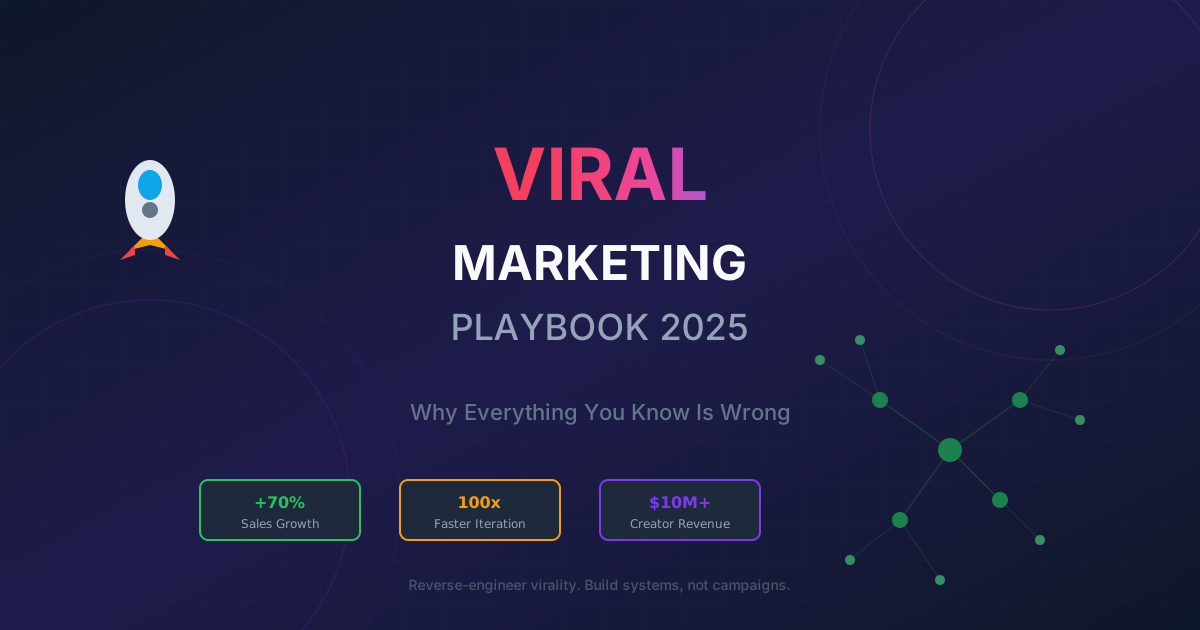
The 2025 Viral Marketing Playbook: Why Everything You Know Is Wrong
Forget luck. Viral marketing in 2025 is reverse-engineerable. Learn the new rules that turned a $12 appetizer into 40% of Chili's quarterly growth, and how AI is rewriting the virality playbook.
Let me be brutally honest: most "viral marketing guides" are useless. They tell you to "create shareable content" and "tap into emotions" as if that's actionable advice. That's like telling someone to "just be funnier" when they ask how to do comedy.
Here's the uncomfortable truth that marketing agencies don't want you to know: viral marketing in 2025 is not an art. It's a science. And it's completely reverse-engineerable.
I've spent the last few months dissecting what actually works in 2025, and the findings are going to challenge everything you think you know about going viral.
The Death of the "Big Campaign" Mentality
Remember when going viral meant spending millions on a Super Bowl ad and hoping it would "break the internet"? That era is dead.
In 2025, the brands winning at viral marketing aren't the ones with the biggest budgets. They're the ones who understood a fundamental shift: virality is now about velocity of experimentation, not quality of individual creative.
This isn't just theory. Let me show you exactly what this looks like in practice.
Case Study #1: How a $12 Appetizer Generated Millions
Chili's didn't set out to create a viral campaign. They stumbled into something more powerful: they recognized organic virality and poured gasoline on it.
In early 2024, people started posting TikToks about the Chili's Triple Dipper — a three-item appetizer platter featuring mozzarella sticks, sliders, and chicken tenders. The key moment that sparked everything? The "cheese pull" — that satisfying moment when someone bites into a mozzarella stick and stretches out the cheese.
Here's what happened next:
The marketing team at Chili's noticed these organic posts and made a critical decision that most brands get wrong: they didn't try to control the narrative. They amplified it.
Their CMO encouraged the team to take "big swings" — essentially giving permission to experiment rapidly without the traditional approval gauntlet that kills most corporate creativity.
The results were staggering:
- Triple Dipper sales increased 70%
- The item became 11% of Chili's overall business
- TikTok virality accounted for 40% of Q3 sales growth
- We're talking millions of dollars in incremental revenue traceable directly to TikTok content
But here's what most people miss about this case study: the "cheese pull" wasn't just visual content. It was a meme template.
When someone posts a cheese pull video, they're not just showing food. They're participating in a ritual. They're saying "I'm part of this." And that ritual was infinitely reproducible — anyone could do their own version.
This is the new viral currency: imitability over shareability.
The Imitability Principle: Why Shareability Is Dead
For a decade, marketers have been obsessed with "shareability" — creating content people want to share with their friends. But the algorithm has changed the game entirely.
In 2025, the most viral content isn't content people share. It's content people recreate.
Think about the most viral trends of the past year:
- The "Very Demure" audio — people recreating their own versions
- AI-generated "Ghibli style" portraits — everyone making their own
- Dubai chocolate — TikTokers racing to taste and review their versions
- The Grimace Shake "death" videos — pure user-generated chaos
None of these were "shareable" in the traditional sense. They were all templates for participation.
This is why old-school viral campaigns fail: they're designed to be admired, not imitated. In 2025, if your content doesn't have a clear "this is how you participate" mechanism, it's not going to spread.
The AI Wild Card: When Machines Learn to Go Viral
Here's where things get really interesting. AI isn't just changing how we create content — it's fundamentally altering the economics of viral marketing.
Remember when going viral required either luck or a huge production budget? AI has demolished that barrier.
In 2025, we're seeing AI-generated content achieve genuine virality:
- Synthetic Summer: An AI-generated beer commercial that sparked millions of views and intense debate
- Pepperoni Hug Spot: An AI-generated pizza commercial that went viral precisely because of its uncanny valley aesthetic
- AI-generated product photos on TikTok Shop that outperform professional photography
But here's the counterintuitive insight: the most successful AI-generated viral content isn't trying to look perfect. It's deliberately imperfect.
The Pepperoni Hug Spot commercial went viral specifically because it looked slightly off. The faces were weird. The pizza looked both appetizing and unsettling. That tension — the uncanny valley — became the talking point.
This reveals something profound about viral content in 2025: controversy and discomfort spread faster than perfection.
The One-Person Viral Machine: Justin Welsh's $10M Playbook
While big brands struggle to adapt, individual creators have figured out the new viral playbook. Justin Welsh built a $10M one-person business by systematically engineering virality on LinkedIn and Twitter.
His approach is the opposite of traditional marketing:
- No big campaigns — daily micro-content
- No production team — just him and a laptop
- No hoping for virality — systematic testing with data
Welsh posts multiple times daily, treats each post as an experiment, and ruthlessly iterates based on performance data. Over six years (2018-2024), he built an audience of millions and a business that generates eight figures annually.
What Welsh understood that most don't: virality isn't about individual pieces of content. It's about building a content engine that produces viral hits reliably.
The Algorithm Truth Nobody Wants to Hear
Here's the uncomfortable reality about viral marketing in 2025: you're not marketing to people. You're marketing to algorithms.
TikTok's algorithm doesn't care about your brand story. It doesn't care about your mission statement. It cares about one thing: watch time and engagement signals.
This means the rules of viral content have fundamentally changed:
Old Rules:
- Hook with your brand
- Tell a story
- End with a call-to-action
- Hope people share
New Rules:
- Hook in 0.5 seconds (or you're dead)
- Create pattern interrupts every 3 seconds
- Optimize for completion rate
- Design for recreation, not sharing
The brands winning at viral marketing in 2025 are the ones who've internalized this architecture. They're not creating "content." They're engineering algorithmic triggers.
The VIRAL Framework: A Practical System
After analyzing hundreds of viral campaigns from 2024-2025, I've distilled the patterns into a framework anyone can use:
What This Means for Your 2025 Strategy
Let me be direct about the implications:
If you're still doing:
- Quarterly campaign planning → You're too slow
- Perfectionist content production → You're wasting resources
- Brand-first messaging → The algorithm doesn't care
- Hoping for virality → You're gambling, not marketing
You should be doing:
- Daily/weekly content sprints
- "Good enough" content at high volume
- Algorithm-first content architecture
- Systematic testing with rapid iteration
The brands that will dominate viral marketing in 2025 aren't the ones with the biggest budgets or the most creative agencies. They're the ones who've built content engines — systems that produce, test, and iterate on content faster than their competitors.
The Uncomfortable Conclusion
Here's the truth that makes traditional marketers uncomfortable: viral marketing in 2025 looks less like marketing and more like product development.
The best viral marketers think like engineers:
- Hypothesis: "This hook format will drive 40% higher completion"
- Test: Produce 10 variations
- Measure: Track completion rate, engagement, shares
- Iterate: Double down on winners, kill losers
- Repeat: Daily
This isn't sexy. It's not the creative genius mythology that marketing loves to perpetuate. But it works.
The Chili's Triple Dipper didn't go viral because of a brilliant creative insight. It went viral because someone on their team was paying attention to organic trends, had permission to move fast, and understood that amplification beats origination.
The AI-generated content going viral isn't viral because the AI is creative. It's viral because AI enables a volume and velocity of testing that was previously impossible.
Justin Welsh didn't build a $10M business because he's the best writer on LinkedIn. He built it because he turned content creation into a systematic process with predictable outputs.
Viral marketing in 2025 is a systems problem, not a creativity problem.
The question isn't "How do I create viral content?"
The question is "How do I build a system that reliably produces viral hits?"
That's a very different question. And it has a very different answer.
Want to apply these principles to your own content strategy? Start with velocity — commit to publishing 3x more content than you currently do, track everything, and iterate ruthlessly. The data will tell you what works. Trust the process, not your creative instincts.
Author

Categories
More Posts

Guerilla Marketing in the AI Era: The Distribution Problem Nobody's Solving
AI made content creation free. Now the real battle is distribution. Learn the unconventional, zero-budget tactics that actually work when everyone else is drowning in AI-generated noise.

Beyond ChatGPT: The Rise of Vertical AI for E-commerce (Shopify, Amazon, Etsy)
Generic AI is failing Shopify store owners. The next wave of profitable Micro-SaaS won't be another chatbot—it'll be hyper-specialized AI trained on your niche. Learn why vertical AI wins, how to build it, and the business model behind niche e-commerce tools.

TopMediai AI Music Generator Review 2025: Create AI Music for Free
Comprehensive TopMediai AI Music Generator review. Discover how to create AI classical music, royalty-free tracks, and professional songs with this powerful AI music generator. Compare features, pricing, and alternatives.
Need a Custom Solution?
Still stuck or want someone to handle the heavy lifting? Send me a quick message. I reply to every inquiry within 24 hours—and yes, simple advice is always free.
Manténte a la vanguardia
Obtén nuevas herramientas primero
Suscríbete para recibir notificaciones cuando lancemos nuevas herramientas IA. Sin spam, solo actualizaciones de producto.