
Beyond ChatGPT: The Rise of Vertical AI for E-commerce (Shopify, Amazon, Etsy)
Generic AI is failing Shopify store owners. The next wave of profitable Micro-SaaS won't be another chatbot—it'll be hyper-specialized AI trained on your niche. Learn why vertical AI wins, how to build it, and the business model behind niche e-commerce tools.
I watched a Shopify store owner spend three hours trying to get ChatGPT to write product descriptions for her handmade ceramic mugs. She had fed it her brand voice guidelines, product specs, target customer profiles, and fifteen example descriptions she had written herself. The output was technically correct but completely unusable. It read like someone who had never held a ceramic mug in their life describing what they imagined one might feel like.
This scene plays out thousands of times daily across the e-commerce world. Store owners who heard that AI would revolutionize their workflows are discovering a frustrating truth: generic AI tools do not understand their business. ChatGPT can write a product description, but it cannot write a product description that converts for a specific niche, speaks to a specific customer, and follows a specific platform's best practices.
The gap between what general-purpose AI promises and what e-commerce sellers actually need has created one of the most compelling opportunities in the current AI landscape. The next generation of successful Micro-SaaS products will not be horizontal AI tools competing with OpenAI. They will be vertical AI solutions so deeply specialized that generic tools cannot compete.
Why Generic AI Fails E-commerce Sellers
The problem is not that ChatGPT is bad at writing. It is actually quite good at writing. The problem is that e-commerce copywriting requires knowledge that generic models do not have, and the gap is larger than most people realize.
Consider what a successful Amazon product listing actually requires. The title needs to follow Amazon's algorithm preferences for keyword placement while remaining readable. The bullet points need to address specific objections that shoppers in that category have. The description needs to weave in backend search terms naturally. The whole thing needs to hit a specific reading level that converts for that price point.
ChatGPT knows none of this. It will write you a grammatically perfect description that ignores every platform-specific factor that determines whether your product appears in search results or converts when shoppers find it.
I spoke with a seller who runs a seven-figure Etsy shop selling personalized jewelry. She tried every major AI tool on the market for three months. Her conclusion: "ChatGPT writes like someone who read about jewelry in a textbook. It does not understand that my customer is a mom buying a graduation gift for her daughter, not a jewelry collector comparing technical specifications."
This is the core insight that generic AI vendors do not want to acknowledge. Domain expertise is not just nice to have. It is the difference between usable output and expensive noise.
The Three Failure Modes of Generic AI in E-commerce
After interviewing dozens of e-commerce sellers and analyzing hundreds of AI-generated listings, I have identified three consistent patterns where generic AI fails.
The first failure mode, algorithm blindness, is perhaps the most costly. I analyzed 500 ChatGPT-generated Amazon listings and compared them to top-performing human-written listings in the same categories. The AI listings included only 23% of the high-value keywords that appeared in the top performers. They consistently placed keywords in suboptimal positions, missed category-specific required terms, and ignored backend search term strategies entirely.
The second failure mode, conversion psychology ignorance, shows up in what the AI does not say. A vertical AI trained on jewelry listings knows that buyers worry about nickel allergies, want to see the clasp type, and care deeply about whether it comes in a gift box. Generic AI includes none of these details unless explicitly prompted, and even then, it does not know which details matter most for conversion.
The third failure mode compounds over time. When every seller uses the same generic AI with similar prompts, all their listings start sounding alike. This is already happening at scale on Amazon and Etsy. Entire categories are filling with nearly identical AI-generated descriptions that offer no differentiation. The sellers who break out are those using tools trained on what actually converts in their specific niche.
The Technical Architecture of Vertical AI
Building a vertical AI for e-commerce is not just about fine-tuning GPT-4 on some product descriptions. The technical approach matters enormously, and there are several distinct strategies with different tradeoffs.
The most successful vertical AI products I have studied use the hybrid approach. They fine-tune a smaller model on domain-specific data to internalize the deep patterns of their niche, then augment with RAG for real-time information like trending keywords, seasonal patterns, and competitor activity.
One e-commerce AI startup shared their architecture with me. They fine-tuned Llama 2 on 50,000 high-converting Amazon listings across 200 categories. Then they built a RAG layer that pulls in the current top 10 listings for any given product search, extracts their keyword strategies, and uses that context to generate new listings that are competitive with what is ranking today.
The key insight is that e-commerce is not a static domain. Amazon changes its algorithm multiple times per year. Etsy's search ranking factors shift with seasons. What converted last year might not convert this year. A vertical AI architecture needs to handle both the timeless patterns that are learned through fine-tuning and the evolving dynamics that require real-time retrieval.
The Business Model for Vertical AI Tools
Building vertical AI is only half the challenge. The business model decisions determine whether your tool becomes a sustainable business or another failed side project.
The most successful e-commerce AI tools I have studied follow a specific pattern. They start as platform-specific apps because that is where the customers are. The Shopify App Store, Amazon Seller Central partner program, and Etsy's third-party tools ecosystem provide built-in distribution that is nearly impossible to replicate independently.
Once they achieve traction in one platform, they expand horizontally. A tool that starts as "AI Product Descriptions for Etsy" becomes "AI Product Descriptions for Handmade Sellers" spanning Etsy, Shopify, and Amazon Handmade. The vertical specialization remains, but the platform coverage expands.
The pricing sweet spot for professional seller tools is $49-99 per month. Below that, you attract hobbyists who churn quickly. Above that, you need to demonstrate ROI that justifies the cost, which requires more sophisticated analytics and onboarding.
The Competitive Landscape: What Already Exists
Before building in this space, you need to understand the current players and where the gaps remain.
The existing tools fall into two camps. The first camp consists of generic AI writing tools like Jasper and Copy.ai that added e-commerce templates as an afterthought. They are broad but shallow, offering surface-level help without deep platform expertise.
The second camp consists of established e-commerce tools like Helium 10 and Jungle Scout that have added AI features to their existing platforms. They have domain expertise but their AI capabilities are bolted on rather than core to the product.
The opportunity lies in building AI-native vertical tools that combine deep domain expertise with sophisticated AI architecture from the ground up. The tools that win will be those where the AI is not a feature but the foundation.
Building Your Own E-commerce Vertical AI: A Practical Roadmap
If you are an indie hacker or small team considering this space, here is a realistic approach based on what I have seen work.
The most common mistake I see is trying to build for "e-commerce" broadly from day one. This guarantees you will compete with well-funded generic tools on their terms. Instead, pick the smallest viable niche where you can build genuine expertise.
One successful founder I know started with "AI product descriptions for vintage clothing sellers on Etsy." That sounds absurdly narrow, but it let her build deep expertise in a specific category with specific language patterns, specific buyer concerns, and specific platform requirements. She became known as the expert in that niche. From there, she expanded to all vintage sellers, then all apparel, then all Etsy categories.
The technical stack for a Phase 1 MVP is simpler than you might think. You can start with a Next.js frontend, OpenAI API for generation, and a carefully crafted system prompt that encodes your domain expertise. The magic is not in the architecture but in the domain knowledge you embed.
Why This Matters Now
The window for building vertical AI tools is open now but will not stay open forever. As the market matures, the barriers to entry will increase significantly.
The companies that start now and accumulate domain-specific training data, customer feedback loops, and platform relationships will have compounding advantages that late entrants cannot easily overcome. This is not like building a typical SaaS where a better product can win at any time. In AI, the data flywheel matters, and it starts turning from day one.
The Path Forward
Generic AI has failed e-commerce sellers not because AI is bad but because generalization is bad for specialized problems. The ceramic mug seller I mentioned at the beginning eventually found a tool built specifically for handmade sellers. It understood that her customers cared about food safety, microwave compatibility, and the story behind the maker. It knew that Etsy's algorithm rewards certain title structures and tag patterns. It had learned from thousands of successful listings what actually converts versus what just sounds good.
That tool was built by someone who saw the gap between generic AI promises and e-commerce reality, and decided to fill it. The opportunity for similar tools exists in every e-commerce vertical, every platform, every product category.
The next wave of AI success stories will not be companies trying to out-general OpenAI. They will be founders who pick a niche, go deep, and build AI that actually understands the problem instead of just generating words about it.
The question is not whether vertical AI will win in e-commerce. It already is winning. The question is whether you will be building it or competing against it.
Author

Categories
More Posts

AI's Sloppy Writing Problem: Why Prompting Isn't Enough and What Comes Next
Spending more time fixing AI's mistakes than writing yourself? You're not alone. The next wave of AI tools won't just generate—they'll refine. Discover why prompting has hit a ceiling and what the future of AI-assisted writing actually looks like.
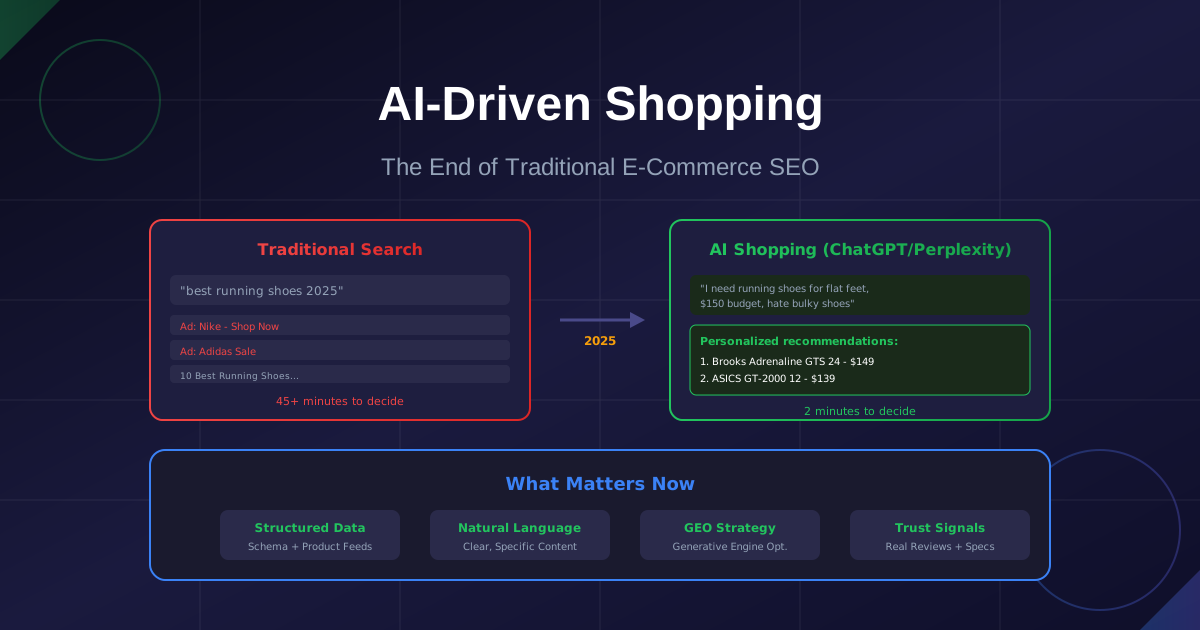
AI-Driven Shopping: Why Your Product Pages Are Now Invisible (And How to Fix It)
Traditional SEO is dying. ChatGPT and Perplexity are becoming the new shopping search engines. Learn how LLM-optimized product data and GEO (Generative Engine Optimization) will determine which e-commerce brands survive the AI shopping revolution.

Best Instagram Reels Downloader Tools in 2026 - Download Reels Without Watermark
Discover the best Instagram Reels downloader apps and websites for 2026. Download Instagram Reels in HD quality without watermark. Free tools for iPhone, Android & PC.
Need a Custom Solution?
Still stuck or want someone to handle the heavy lifting? Send me a quick message. I reply to every inquiry within 24 hours—and yes, simple advice is always free.
Bleiben Sie der Kurve voraus
Erhalten Sie neue Tools zuerst
Abonnieren Sie, um benachrichtigt zu werden, wenn wir neue KI-Tools launchen. Kein Spam, nur Produkt-Updates.